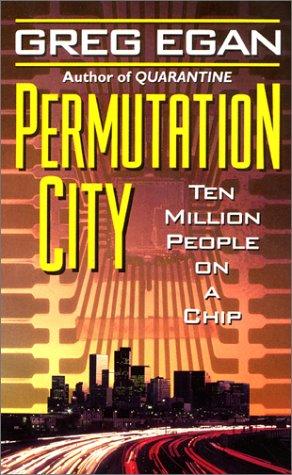
Egan front loads this with enough tech jargon that I nearly gave up in the first fifty pages, virtual copies, dust theory, cellular automata explained at a clip that assumes you already have half a physics degree. I do not. I pushed through anyway because a friend told me the payoff was worth it and she was right, mostly, though I’d be lying if I said every page landed the way the concepts clearly wanted it to.
The premise: by 2050, wealthy people can scan themselves into software “Copies” before death, running at whatever speed money buys, legally and ethically ambiguous in ways the book takes seriously instead of hand waving. Maria, one of the more fleshed out characters Egan’s ever written by his own usual standard, gets pulled into a scheme by a man named Durham whose calm monomania is genuinely well drawn, not just a mouthpiece for the idea. The argument itself, that a consciousness computed in any order, scattered across any medium, would still experience continuity, is the kind of thing that sounds like a party trick until you sit with it for an hour and start to feel queasy about what “continuous” even means.
Egan gets fairly criticized for weak character work in his other books and I can see why, here Maria and Durham carry enough weight that the ideas don’t feel like they’re floating free of anyone to hold them, but the back half, once the simulated universe called Elysium takes over the plot, thins out again into pure concept delivery. Worth the difficulty. Not a book I’d hand someone as their first Egan, Quarantine’s an easier on ramp, but as pure science fiction of ideas this is near the top of what I’ve read.